MS-PINPOINT · News
Deep grey matter loss is what drives disability worsening in MS
An Annals of Neurology study led by Dr Arman Eshaghi analysed 3,604 MRI scans and found that of all regional brain volumes, only deep grey matter predicted time to disability progression.
 Written byMS-PINPOINT Team
Published
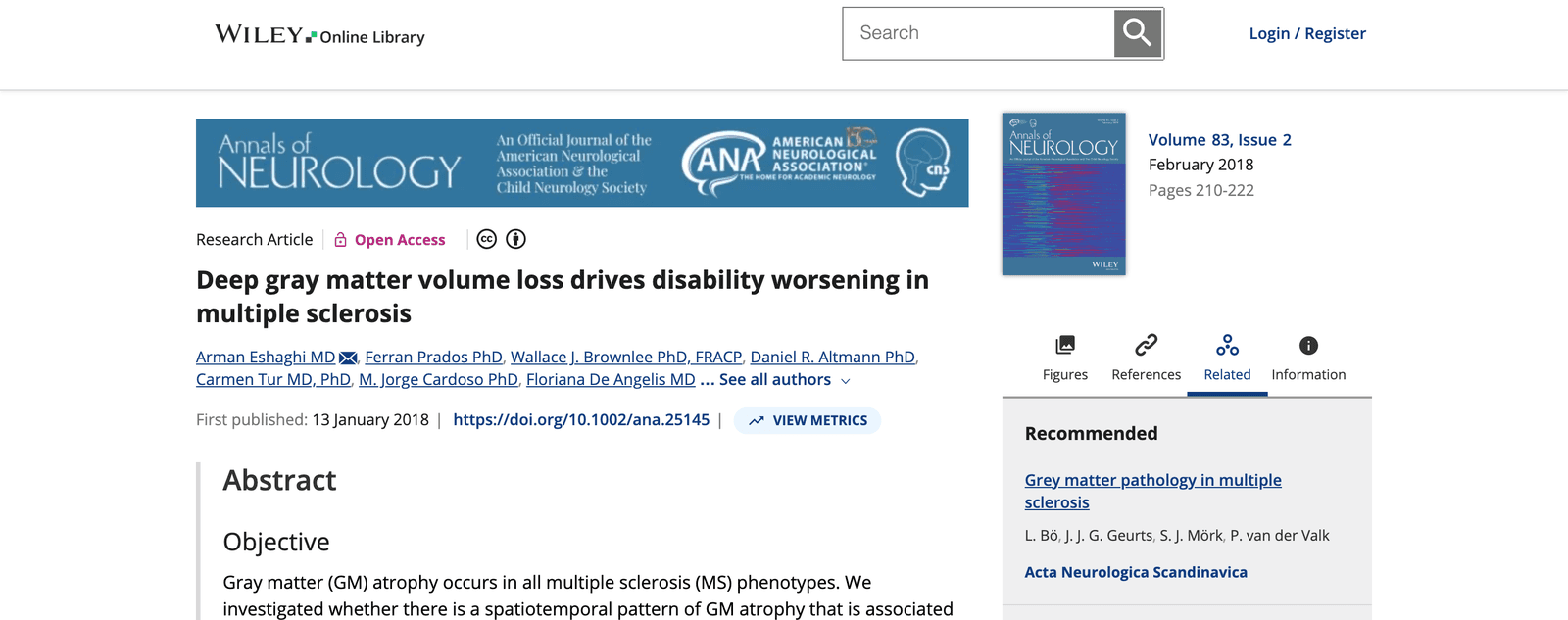
Grey matter atrophy occurs in every phenotype of multiple sclerosis. The clinically useful question is narrower: is there a particular pattern of tissue loss, in a particular place, that tells you who will get worse?
This Annals of Neurology study, first-authored by Dr Arman Eshaghi, analysed 3,604 high-resolution T1-weighted brain MRI scans from 1,417 participants attending seven European centres — 1,214 people with MS across all four phenotypes, plus 203 healthy controls — with an average of 2.41 years of follow-up. Volumes were obtained for the deep grey matter, temporal, frontal, parietal, occipital and cerebellar grey matter, brainstem and cerebral white matter, and hierarchical mixed models were used to relate them to time-to-EDSS progression.
The answer was unusually clean. Of all the baseline regional volumes measured, only deep grey matter volume predicted time to disability worsening (hazard ratio 0.73; 95% CI 0.65–0.82; p < 0.001) — for every standard deviation of deep grey matter lost, the risk of worsening sooner rose substantially. Secondary progressive MS showed the lowest baseline cortical and deep grey matter volumes of any group. Deep grey matter is not simply one atrophy measure among many; it is the one that carries the prognostic signal, which makes it a strong candidate outcome measure for trials.
Read the paper: Deep gray matter volume loss drives disability worsening in multiple sclerosis.