Open-source software
MindGlide
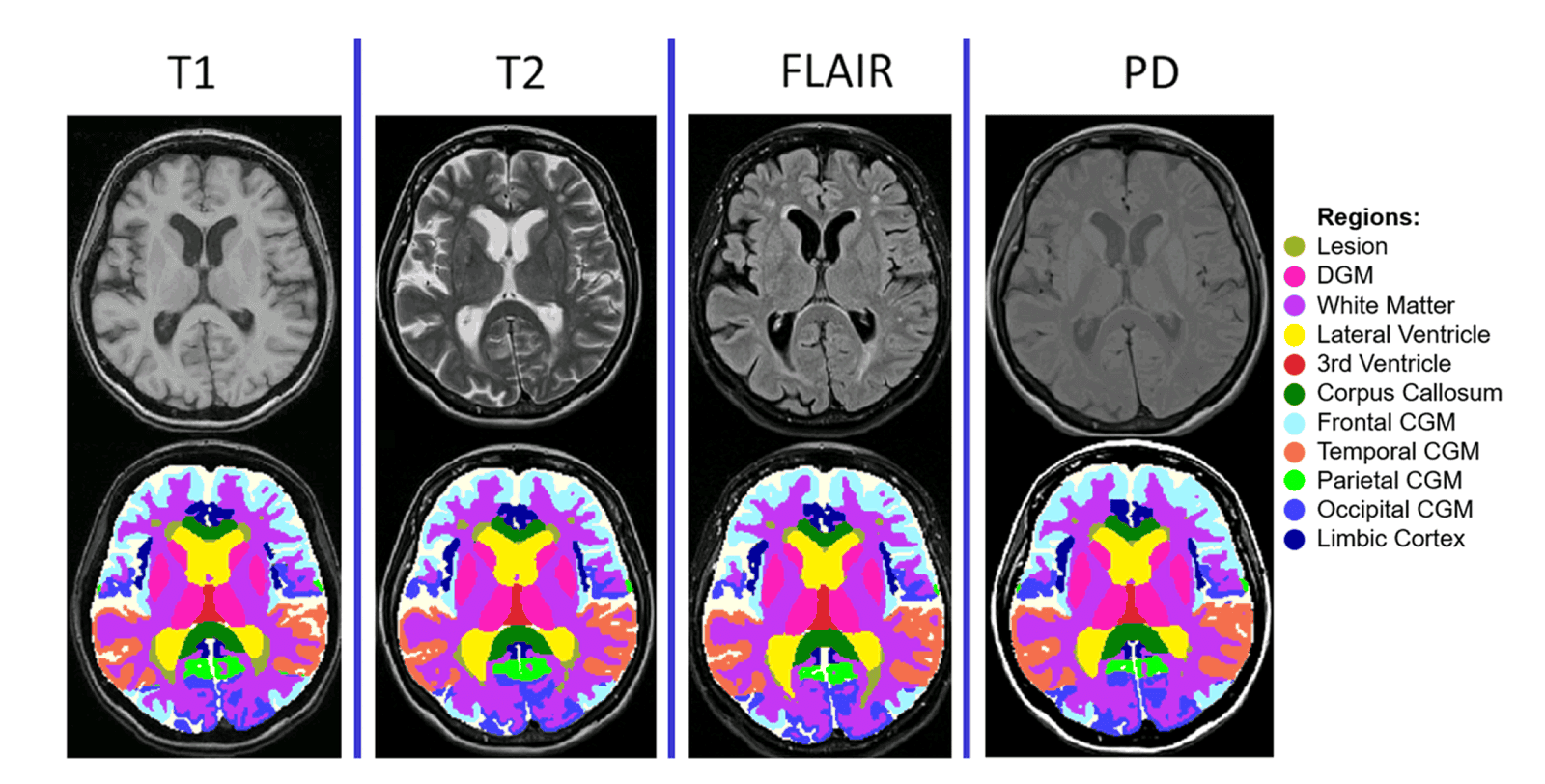
A deep-learning model that measures lesion burden and regional brain volumes from a single routine MRI contrast — no research protocol required.
Try MindGlide
Local in-browser brain segmentation
Your MRI and results stay on your device. Processing happens locally in your browser.
Hospitals have been storing MRI for decades. Almost none of it was usable for research.
Quantitative MRI analysis has generally needed multi-contrast research protocols — carefully specified sequences acquired the same way every time. Clinical scans are not like that. They are acquired for a radiologist to look at, on whatever scanner the hospital owns, with whatever sequences that clinic favours.
That mismatch is why archives holding hundreds of thousands of scans have contributed so little evidence. MindGlide removes the dependency on the research protocol, which turns those archives into datasets.
What it was built and tested on
Training
- MS scans used for training
- 4,247
- MS scans used for training
- patients
- 2,934
- patients
- different scanners
- 592
- different scanners
External validation
- scans in external validation
- 14,952
- scans in external validation
- patients
- 1,001
- patients
- MRI contrast required, instead of a research protocol
- 1
- MRI contrast required, instead of a research protocol
Against expert-labelled lesion volumes, MindGlide outperformed comparator tools. More usefully, it detected treatment effects on lesion accrual and grey-matter loss in progressive MS trial data — including from contrasts not normally used for those outcomes.
Use it, or tell us where it breaks.
MindGlide is released with its trained models and a container, so it should run on your data without a rebuild. If you are applying it to a cohort we have not seen, we would like to hear about it.