Wellcome Career Development Award
A lab to turn everyday hospital scans and notes into earlier, fairer MS care
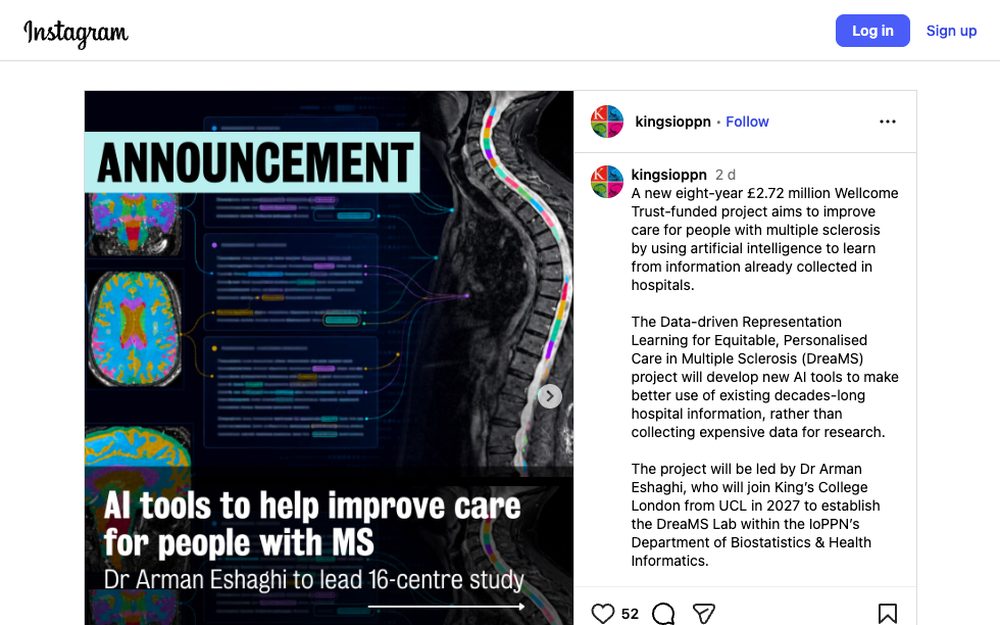
DREAMS — Data-driven Representation Learning for Equitable, Personalised Care in Multiple Sclerosis — is an 8-year, £2.72M project at King's College London, in partnership with King's College Hospital.
More than three million people live with MS, and the condition behaves differently in every one of them. The information needed to understand those differences already exists — it is sitting in hospital systems right now.
Almost none of it is usable by today's AI. It is messy: pictures and free-form English rather than tidy tables, taken on different scanners, at different hospitals, to no common recipe. So research keeps being done on small, carefully curated datasets from a handful of specialist centres — and the answers arrive late, and rarely fit the person sitting in the clinic room.
What hospitals already hold
Three kinds of everyday record, already collected in ordinary care
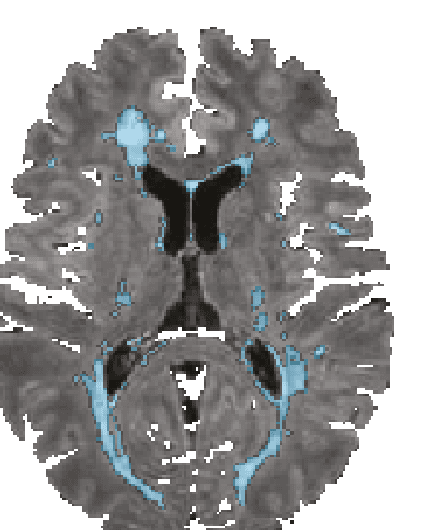
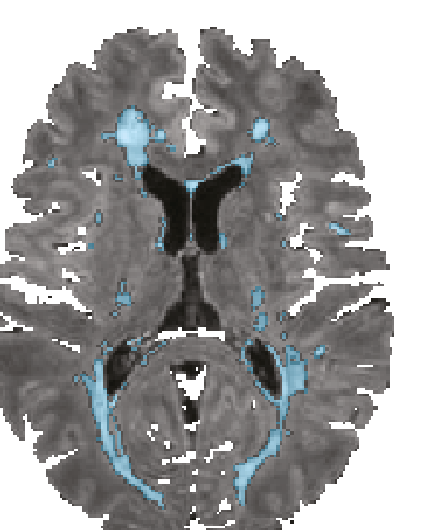
A routine brain scan with MS lesions highlighted by our models. From our own published work.
01
Brain MRI
Every MS clinic takes MRI scans of the brain, year after year, on whichever scanner the hospital happens to own. Research usually throws most of these away, because they were not acquired to a common recipe. We would rather learn from them.
02
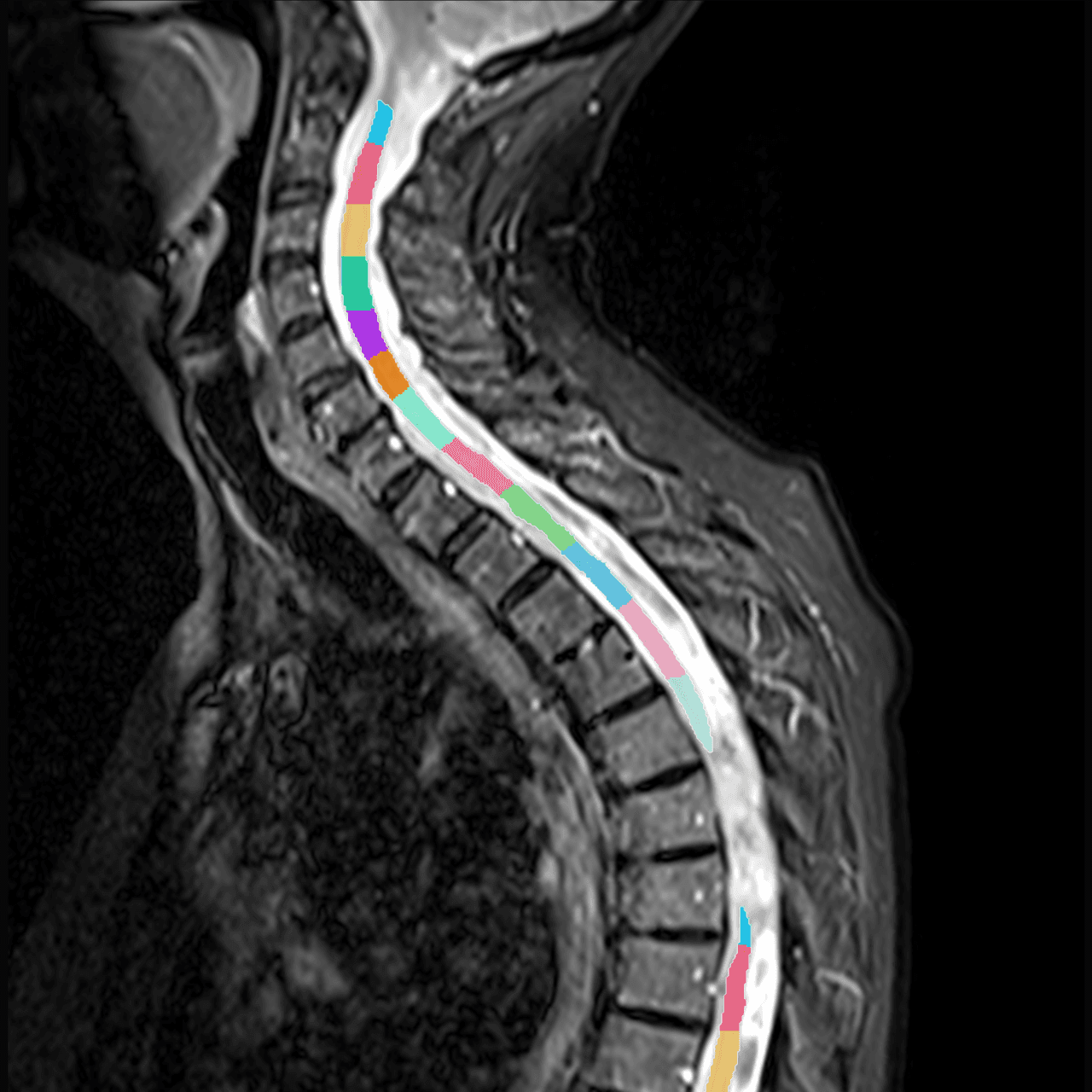
Spinal cord MRI
Damage to the spinal cord is what often drives difficulty walking, bladder problems and fatigue — and it is measured far less often than the brain, because doing it reliably is technically hard. Making that measurement routine is a specific aim of the lab.
03
Clinical notes and reports
Nursing notes, patient correspondence and neurology clinic letters: written in free-flowing English, full of meaning that no spreadsheet ever captures. With appropriate safeguards and clinical validation, language models can help read this at scale and map it to candidate measures of how someone's MS is changing.
Scroll the records. Each highlighted phrase is evidence a language model could map to a candidate clinical signal.
Three entirely synthetic examples, modelled on the different forms free text takes in UK and US hospital systems.
Northbridge University Hospitals
Centre for Neurosciences | MS Nursing Service
Entirely synthetic no real patient or provider
Telephone encounter
Multiple sclerosis nursing note
Signed
Reason for contact
Patient called to discuss a gradual change in mobility. No fever, urinary symptoms or recent infection. No sudden onset and no new visual symptoms.
Patient account
Previously able to walk continuously for around 30 minutes; now right-leg heaviness makes them stop after around 10 minutes. The toes sometimes catch on uneven ground. Rest helps, but the change is now present most days.
Assessment and action
Subacute functional change without a clear infective trigger. Discussed pacing and falls safety. Added to MS multidisciplinary review and requested earlier neurology follow-up.
Lakeshore Health
MyHealth patient portal
Messages Records Visits
Entirely synthetic no real patient or provider
Care-team reply | 9:18 AM
Thank you for describing the timing so clearly. We have sent this to your neurologist and will contact you to complete a symptom review.
Northbridge Neuroscience Centre
Department of Neurology | Demyelinating Disease Clinic
NNC / NEURO / 06
Entirely synthetic no real patient or provider
Dr Example
Riverside Medical Practice
Northbridge
Re: SYNTHETIC, Patient C
Demo record: DEMO-UK-0188 | No valid patient identifiers
Dear Dr Example,
I reviewed this patient in the multiple sclerosis clinic. There has been no discrete relapse since the last appointment. They describe increasing fatigue, reduced walking distance and new difficulty with fine finger movements over approximately six months.
Examination
Mild right hip flexion weakness, slowed left finger tapping and a broader-based gait. Timed 25-foot walk was 6.8 seconds, previously 5.2 seconds in the demonstration record.
Imaging review
Routine brain MRI was compared with the prior study. The report describes two additional small T2 lesions, with no enhancement.
Impression and plan
Gradual disability worsening without a clear clinical relapse, alongside interval MRI activity. We will review current disease-modifying therapy at the MS multidisciplinary team meeting, arrange physiotherapy assessment and repeat objective walking measures.
Yours sincerely,
Dr N. Example
Consultant Neurologist (fictional)
What makes DREAMS different
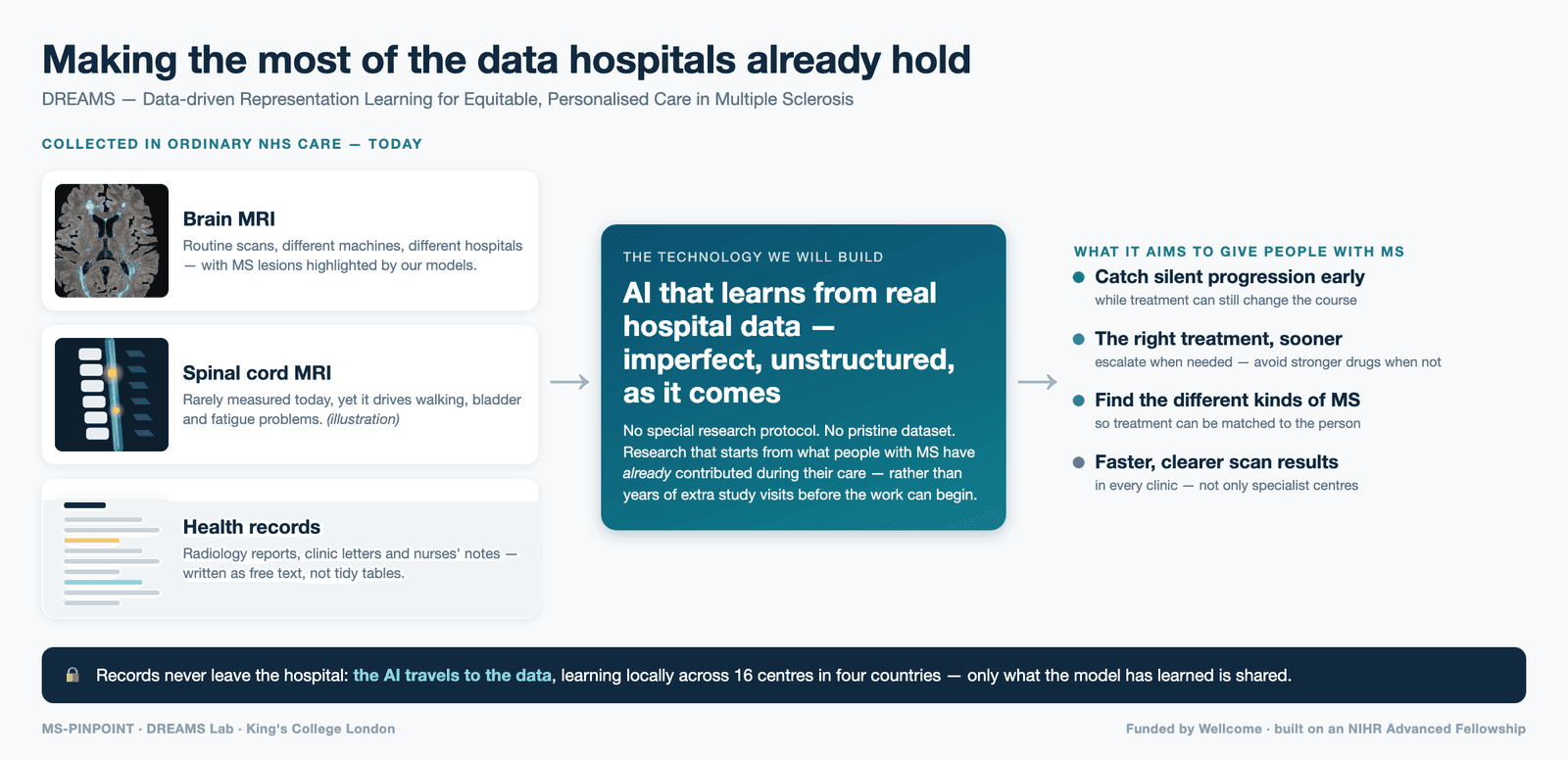
We are building the missing technology: AI that learns directly from the imperfect scans and free-text notes every hospital already produces — no special research protocol, no pristine dataset.
This is what lets us make full use of the information people with MS have alreadycontributed through their routine care. Prospective studies remain essential, but they often require years of additional visits and scans before the science can even begin. DREAMS is designed to learn from what is in the record today, so patients' time and generosity count for as much as possible.
That capability does not yet exist for MS. It is the core of what the lab will build over the next eight years, and we will release it openly, so others — in MS and in other neurological conditions — can use it.
What it could mean
The technology is the means. These are the ends we are working towards.
Each one starts from a scan or a letter that already exists in a hospital record.
Catching progression while something can still be done
MS often worsens quietly, between relapses, and the change is too gradual to see by eye. DREAMS aims to measure it reliably from ordinary clinical MRI — so treatment can be reviewed while damage is accumulating, not years later once disability has become permanent.
The right treatment, sooner
MS treatments range from gentle to powerful, and choosing between them is largely a judgement call today. By predicting who is at high risk of disability in the coming years, we want to help people escalate early when that is warranted — and avoid stronger drugs, and their risks, for people who do not need them.
Finding the different kinds of MS
“MS” is almost certainly several diseases wearing one name. Learning from tens of thousands of real patients, rather than a few hundred, gives a genuine chance of identifying subtypes and matching treatments to them.
Care that does not depend on your postcode
Because our models are built for the scans an ordinary district hospital already does, the benefits should reach general neurology clinics — not only large specialist centres. Equity is in the project's name because it is a design requirement, not an afterthought.
Faster, clearer scan results
Radiology waiting lists are long and reports vary between readers. AI assistance for MRI reporting aims to shorten the wait for results, and reduce the chance that a meaningful change is missed.
Better clinical trials, sooner
More sensitive measures of progression mean future trials can be smaller and quicker — so promising treatments reach people years earlier than they otherwise would.
None of this arrives overnight. This is an eight-year programme of research, and every step will be validated before it goes anywhere near a clinical decision.
Where the data stays
Your records never leave your hospital. The AI travels instead.
DREAMS spans 16 hospitals and research centres across four countries — 12 in the UK, plus the Netherlands, Canada and South Korea. Instead of moving patient records to us, each hospital's models learn locally from anonymised information, and only what the model has learned is shared. This is called federated learning, and it lets us learn from a large, diverse group of people with MS without their data ever being pooled or handed over.
People living with MS and their carers helped design this project from the start through our Patient and Public Advisory Board, and will keep guiding it throughout — including which outcomes are worth predicting in the first place.
16 centres · 4 countries
- Records shared
- None
- Models shared
- All of them
Built on an NIHR Advanced Fellowship
DREAMS would not exist without my NIHR Advanced Fellowship (2022–2027). It built the MS-PINPOINT collaboration and the federated infrastructure that 12 of the 16 DREAMS centres already share. I am deeply grateful to the NIHR for that support.
Thank you
This award is the product of many people's generosity. My thanks to my colleagues and mentors at UCL, where this work grew — the MS clinic at UCLH, and the NMR Research Unit within the Department of Neuroinflammation at the UCL Queen Square Institute of Neurology — and to the wider Queen Square community of clinicians, physicists and researchers who supported it. Thank you to my mentors and collaborators at King's College London and King's College Hospital, including Professor Richard Dobson and Professor James Teo, and to colleagues at the Montreal Neurological Institute, whose partnership underpins the imaging work. I am grateful to old and future colleagues across our international centres, and to the departments and teams — too many to name individually — who backed this application at both UCL and KCL. Most of all, thank you to the students and postdocs I have had the privilege to work with, past and present, and to the people living with MS whose insight and generosity shape everything we do.
Join us
The DREAMS Lab is recruiting. Over the coming years we will grow a team of postdoctoral researchers, a research assistant, and PhD students around data curation, neuroimaging, clinical language modelling and multimodal AI. If you are excited about building robust, real-world medical AI that actually reaches patients — whatever your background in machine learning, imaging, NLP or clinical research — I would love to hear from you.
Coverage
Where the award was written about elsewhere.
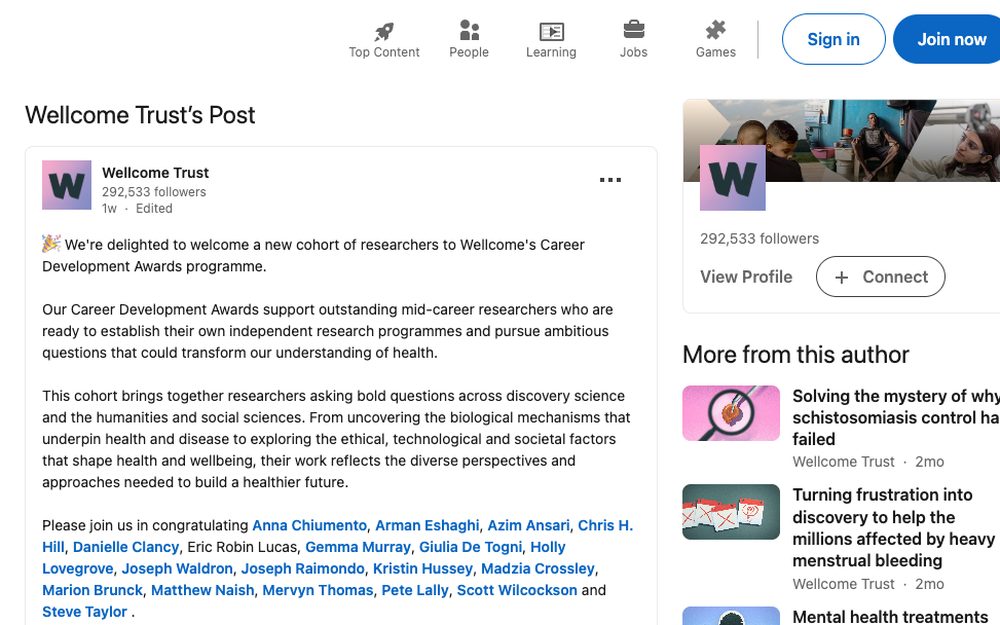
- Wellcome on LinkedInA new cohort of Career Development Award holderslinkedin.com(opens in a new tab)
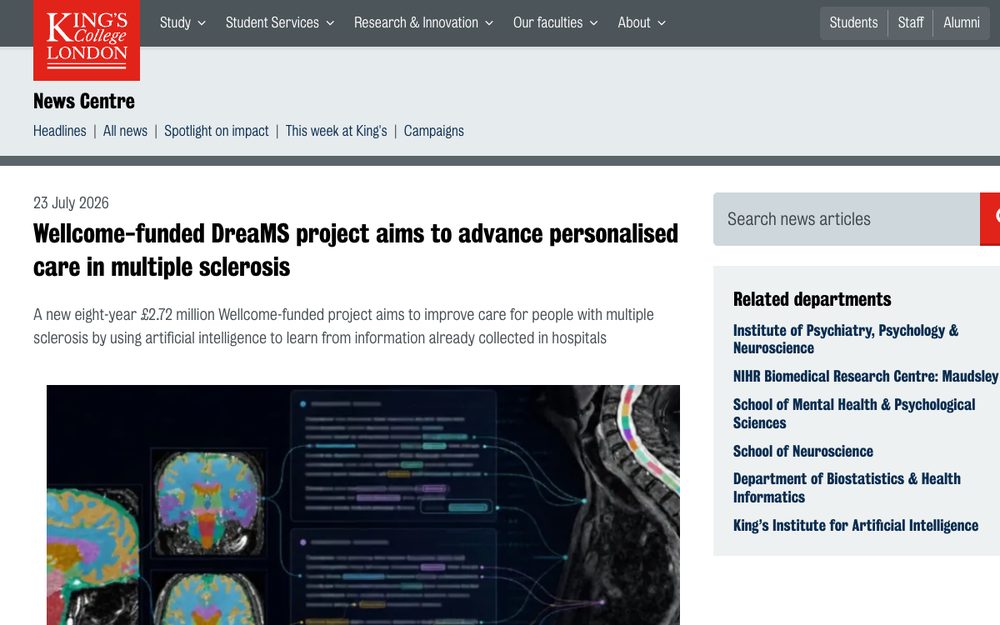
- King's College LondonWellcome-funded DreaMS project aims to advance personalised care in multiple sclerosiskcl.ac.uk(opens in a new tab)
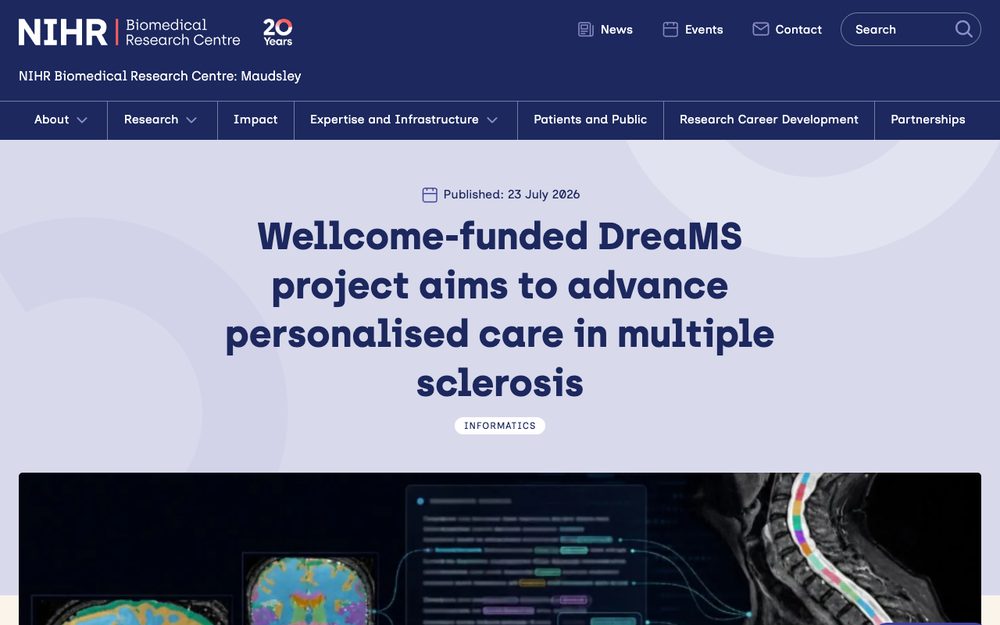
- NIHR Maudsley BRCNew DREAMS centres across South East Englandmaudsleybrc.nihr.ac.uk(opens in a new tab)
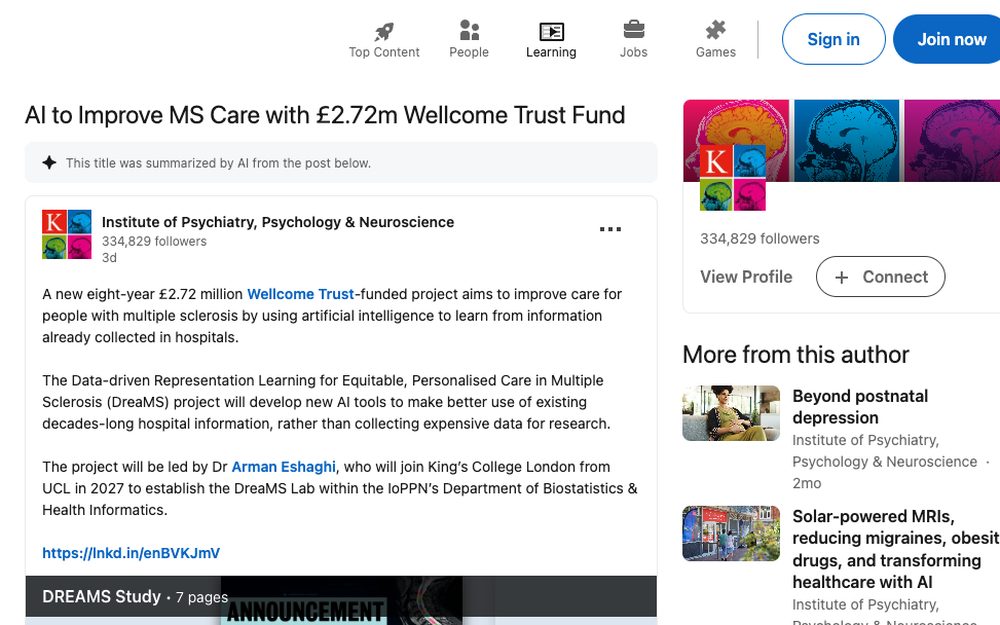
- IoPPN on LinkedInThe DREAMS study announcementlinkedin.com(opens in a new tab)
- IoPPN on InstagramThe DREAMS study announcementinstagram.com(opens in a new tab)